What it's about
Early passive shoulder movement is crucial for preventing adhesions and stiffness.
Motorized CPM devices enable precise, hours-long passive movements that have a relaxing effect.
Continuous passive movement promotes joint lubrication, which medications cannot do.
Despite its size, device therapy can be easily integrated into everyday life; consistency is key here.
CPM therapy does not replace later physiotherapy, but creates its important foundation.
After shoulder surgery, the first impulse is often to rest the arm and wait. But modern rehabilitation medicine clearly shows: early passive movement is a central building block of healing, not a risk. Those who understand why this is the case and how the first few weeks are structured recover faster and with fewer complications.
Why does rehabilitation start just a few days after surgery?
The shoulder joint reacts sensitively to immobilization. However, too long a period without any movement promotes the formation of Adhesions, the muscles shorten and the joint capsule loses elasticity. These processes are not unavoidable; they can be slowed from the outset with consistent passive mobilization.
In the first phase after shoulder surgery, which usually covers the first six weeks, only passive movements are allowed. This means: The arm is moved without the shoulder muscles actively working. Two methods are the main focus:
Pendulum exercises: The upper body is bent forward, the arm hangs relaxed and swings due to gravity.
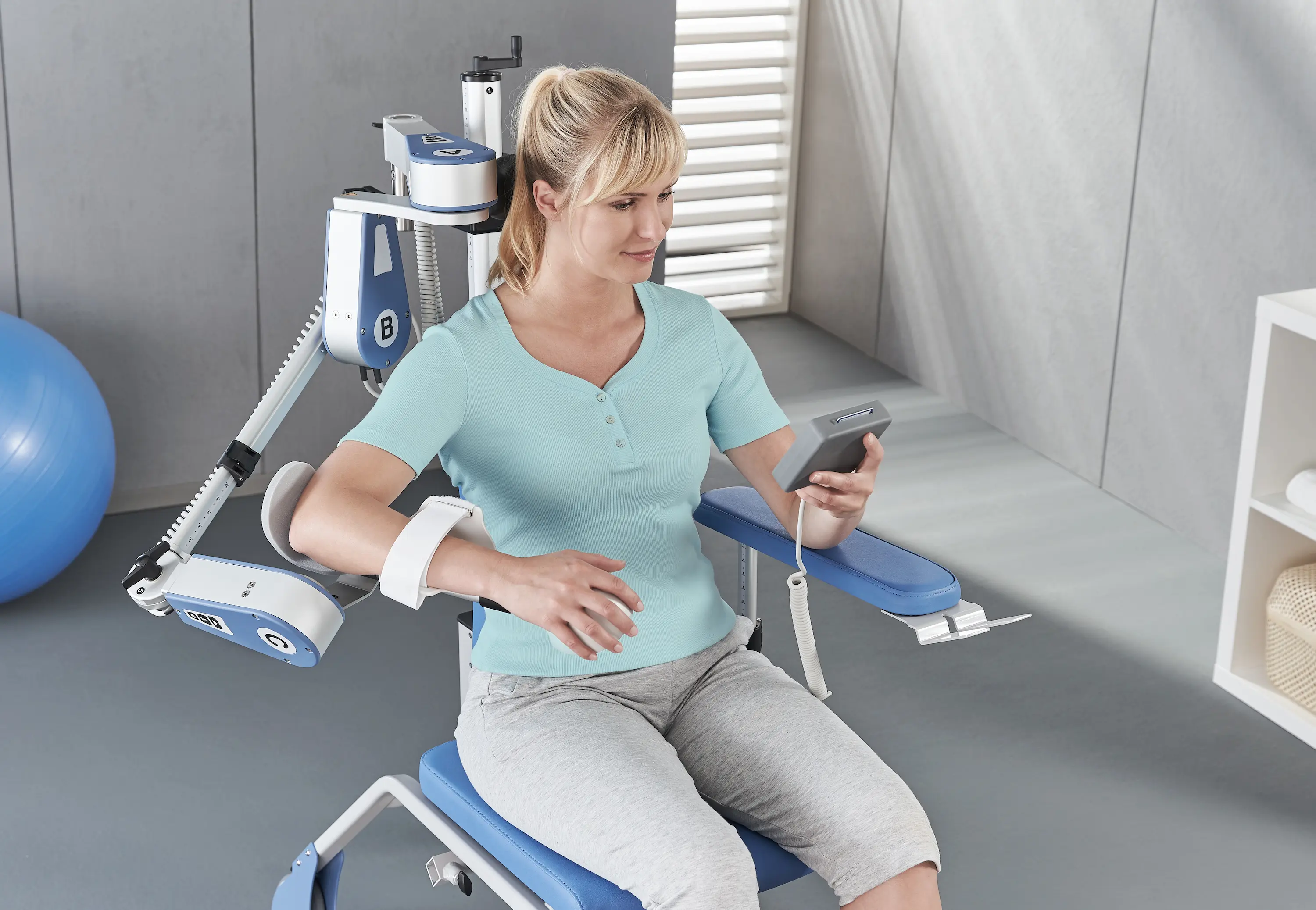
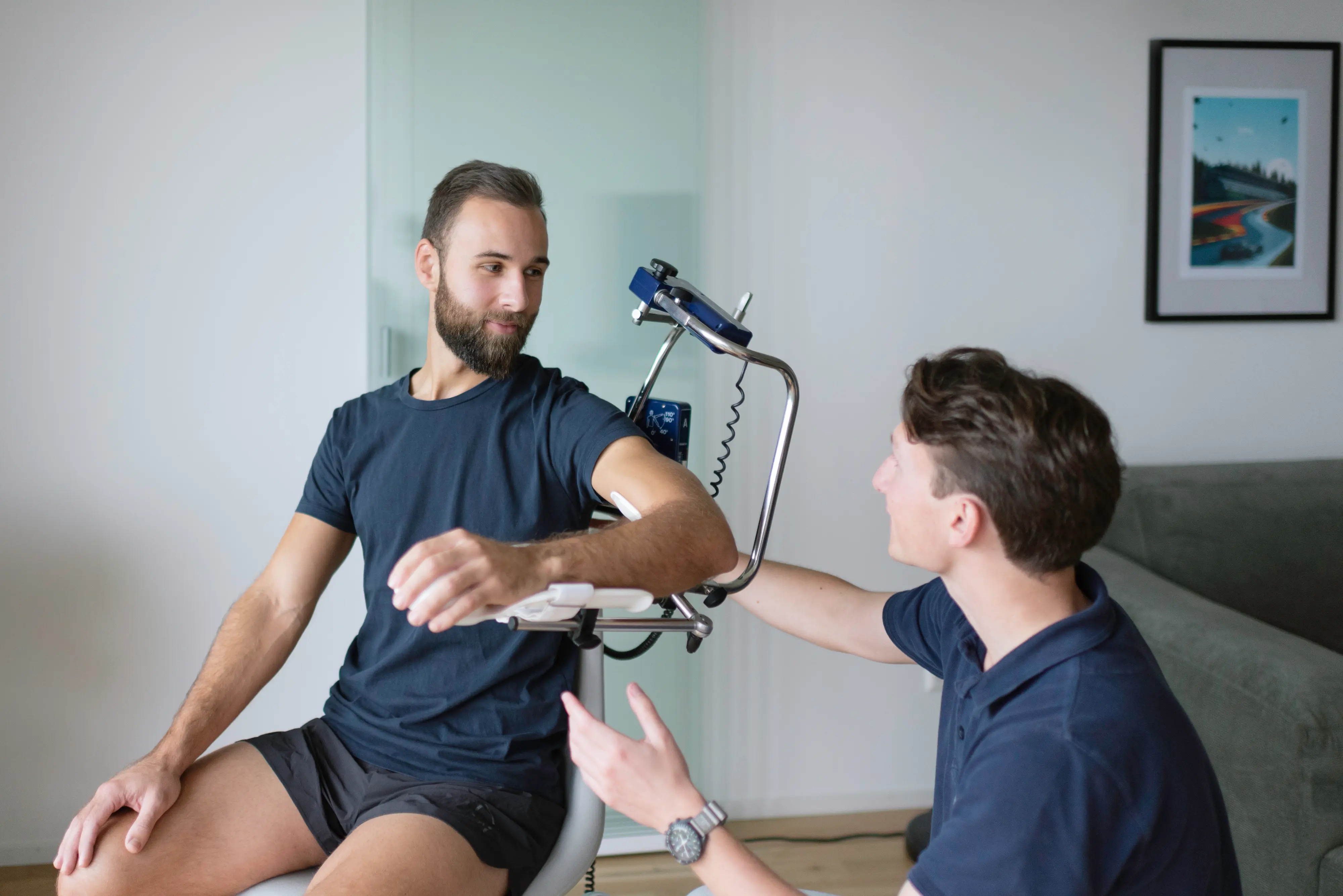
Motorized CPM device: Controlled, passive mobilization of the shoulder using a motorized CPM device along defined directions of movement.
Both methods complement each other. The motorized device takes over the largest part of the daily therapy time and offers something that pendulum exercises cannot provide: precise, reproducible movements over several hours.
What does the motorized CPM device do in shoulder rehab?
CPM therapy (Continuous passive motion) for the shoulder is based on a simple but effective principle. The device guides the arm in smooth, monotonous movement sequences that are individually adjusted: direction of movement, range of angles and speed are adapted to the procedure and the patient's healing status.
What often surprises patients: The muscles relax noticeably through these rhythmic movements. They describe the application as soothing, not stressful. This is because the brain associates steady stimuli with safety and reduces the protective tension in the muscles.
“The device moves the arm in all predetermined directions. The muscles can relax through these monotonous movements, and many patients find this very soothing.”
Clinically relevant is also the promotion of synovial fluid, which nourishes and protects the joint. Passive movement stimulates its production, while rest inhibits it. This is a mechanical advantage that no medication can fully replace.
What does the therapy protocol look like in the first 6 weeks?
The guidelines for the passive phase are clear and should be followed consistently. Deviations, especially interruptions to the daily routine, measurably delay the healing process.
Parameter | Recommendation |
|---|---|
Total therapy duration | 6 weeks |
Sessions per day | 6 to 10 |
Duration per session | 20 to 30 minutes |
Start | First day after surgery |
Type of movement | Exclusively passive (no active muscle work) |
That sounds like a lot, but it can be integrated well into everyday life. Many patients use the sessions while watching TV, reading or talking on the phone. The device runs independently and requires no active participation other than sitting calmly in the correct position.
Important: These exercises must be performed carefully and conscientiously. A daily program that is too short or frequent omissions compromise the result, even if the total duration of six weeks is formally observed.
When and how do I receive the device?
In some cases, the motorized shoulder CPM device is brought to the room during the hospital stay so that therapy can begin directly on the first postoperative day. For other patients, use starts 5–7 days later at home. The exact timing depends on the type of surgery and the doctor’s prescription.
WINTER Medizintechnik coordinates this process for patients throughout Switzerland. The basis for this is decades of close collaboration with renowned Swiss doctors and clinics, whose professional exchange directly benefits patient care. Through the rental service for shoulder CPM devices the device is delivered, individually adjusted and explained on site. Anyone who would like to order the device directly to their home can simply fill out the order form for the shoulder online.
The personal instruction is an integral part of the service. The devices can be finely adjusted and therefore tailored individually to the patient. An incorrect setting can delay the healing process or cause pain. Correct instruction is therefore not an optional extra, but a prerequisite for effective therapy.
What happens after the first 6 weeks?
The passive phase is the foundation, not the goal. As soon as the tissue has healed sufficiently, usually after about six weeks, physiotherapy is switched to active-assisted movements. The muscles then begin to take over work again, initially with support, later independently.
This transition should always take place in consultation with the treating doctor. The motorized device is usually returned in this phase, as its specific task, exclusively passive mobilization, has been fulfilled.
For the later phase of rehabilitation, when stability and strength are rebuilt, supplementary aids can be useful.
Frequently asked questions about shoulder rehab with a CPM device
Is the therapy painful?
The therapy should not be painful at any time. The motion angles are set so that they remain below the pain threshold. A slight pulling sensation is normal. However, if sharp or persistent pain occurs, this is a clear signal: stop the application immediately and have the setting checked without delay.
Can I also use the device at night?
Especially at night, many patients experience severe pain after shoulder surgery when the shoulder comes to rest. The CPM device can help in such moments: a short movement session of 5 to 10 minutes releases the protective tension in the muscles, noticeably relieves discomfort and often makes it possible to sleep again afterwards. Whether and how the device should be used at night is best discussed with the treating doctor.
Does the CPM device help make the shoulder mobile faster?
Yes, and this is one of the central reasons why CPM therapy is used so consistently postoperatively. The motorized CPM device keeps the joint moving every day before the muscles are even allowed to be used actively. This prevents adhesions from forming and the joint capsule from stiffening. Anyone who completes the passive phase fully and regularly creates the best starting point for subsequent physiotherapy and progresses more quickly to active loading.
Does CPM therapy replace physiotherapy in the first 4 to 6 weeks?
No, it does not replace physiotherapy. In the early postoperative phase, however, CPM therapy is often sufficient and sometimes also the only sensible option: As long as only passive movements are allowed, the muscles must not yet be loaded.
Many doctors recommend working primarily with the CPM device in the first 4 to 6 weeks. The exact approach depends on the procedure and the healing process.
Active therapy is essential as soon as the passive phase is complete. The CPM device creates the foundation; strength and function are then built up through targeted physiotherapy. The two forms of therapy are sequential steps, not alternatives.
For which shoulder surgeries is CPM suitable?
CPM is used after various shoulder surgeries, including rotator cuff surgeries, shoulder prostheses and arthroscopic procedures. The exact indication is determined by the operating doctor. Which device is suitable for which procedure is shown in the article about the comparison of Artromot shoulder CPM devices.
Do you have questions or would you like to rent a device?
We will be happy to advise you personally and take care of fast, uncomplicated delivery directly to your home or to the hospital. Simply call us or conveniently order the device online using our order form for shoulder CPM devices.
WINTER Medizintechnik AG
Phone: 071 351 68 68